
The Science
and Art of
Problem Solving
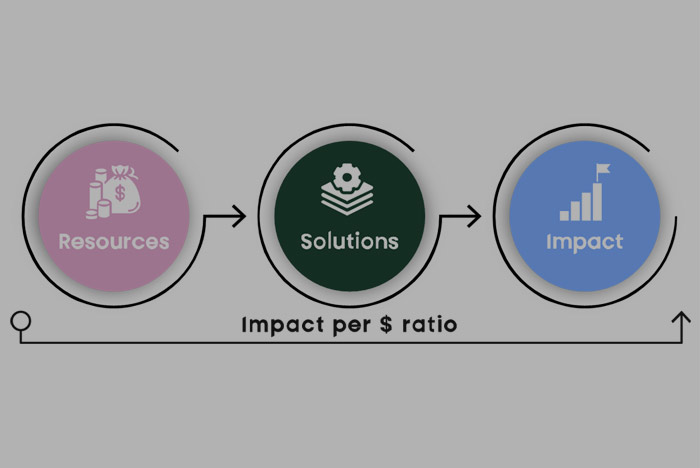
Ensuring that change-makers get the most impact per dollar invested

ERI is a global research and consultancy firm that brings together an elite team of data scientists, systems thinkers, and experienced problem solvers.

More about ERI

Core Services

Systemic Impact per $ Measurement

Change Makers need to know which investments would yield the highest Impact per $. We calculate the Impact per Dollar on impact investments by getting to the heart of complicated problems and identifying their systemic causes with exacting use of data and evidence.

Read More

Data Science in the Service of Impact

Transforming large datasets into actionable insights is key to understanding social problems and can effectively change how to approach their solutions. Our services include the full range of what analytics have to offer: from bread-and-butter statistics to data-science, adapted to your needs and calibrated towards extracting the most useful insights for your mission.

Read More

Knowledge Maps

A product that offers a comprehensive answer to the question of what it would take to actually solve a social problem. Knowledge maps employ the most sophisticated methods available to the scientific community to generate clear and actionable answers to questions such as: What is the real problem? What are its root causes? What do we need to invest in order to solve it? How should each investment be planned in order to get the most impact per dollar?

Read More

What Works

The biggest challenge to impacting social change is not lack of resources, but rather that resources are all too often invested in solutions that don’t really work. Our “What Works” products offer a comprehensive mapping of the most effective interventions for achieving real social impact, as well as concrete recommendations on how to use this mapping to design the most effective interventions in a given context

Read More

Measurement & Evaluation

How can you tell whether an intervention or policy is really working? We employ advanced quantitative and qualitative methods to determine (a) whether an intervention or policy is working and (b) what needs to be done to improve its effectiveness and efficiency. When evaluating a new intervention, we often offer Randomized Controlled Trials (RCTs) – testing an intervention in the same way you would test a new drug, using randomly allocated treatment and control groups.

Read More

Multidimensional Index

Some things are inherently difficult to measure because they are complex. These include poverty, social cohesion and social mobility. We have developed a method to measure the complex, using a multi-dimensional approach that measures the variety of aspects that constitute a complex concept and integrates these aspects into a single quantitative index.

Read More

Evidence-Based strategy

Strategy and policy design require clear answers to two questions: “What do we want to achieve?” and “How are we going to get there?” To answer these questions, we begin by crystalizing your goals and objectives and designing dashboards where needed, after which we then turn to the evidence and data on what has worked and failed in the past. We then build upon that knowledge base to articulate an innovative answer to what will work today and in the future.

Read More

Previous
Next

Who we work with

By blending best-in-class data science with systems thinking and strategic insight, we equip organisations comitted to solving today’s most urgent challenges with the intelligence they need to maximise their impact per dollar.

Non-Profit Funders

Philanthropic funds and global foundations seeking to allocate capital effectively

Large NGOs

Operating independently of governments with a focus on social, humanitarian or environmental missions

For-Profit Impact Investors

VCs and family offices aiming for both financial returns and meaningful impact

Featured in:

Our impact in the media

268,000 Israelis have fallen into poverty during pandemic, charity says

Latet annual report finds estimated 850,000 families in Israel lack essential housing, education, healthcare and food; half of general population reports significant economic damage as need for financial help jumps by 70%

Thousands of Israelis pushed into poverty amid COVID-19 pandemic - report

Compared to the year before, some 268,000 new households – around 3% of the population – were pushed into poverty.